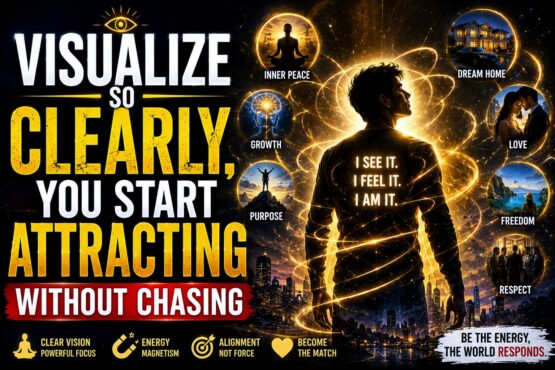
The Reality of Visualization
You’re already visualizing. Maybe nobody told you that clearly enough. Visualization isn’t only what happens when you close your eyes, light a candle, sit perfectly still, and imagine some perfect future version of your life. Most of the time, it’s much quieter than that. It’s the little movie playing in your mind while you’re brushing your teeth. It’s the image you carry when you check your bank account. It’s the scene you expect before you walk into a room, send a message, apply for an opportunity, or look at yourself in the mirror.
Before life ever answers you, your inner world has usually spoken first. And that’s where things get interesting. Because many people say they want a new reality, but internally, they keep rehearsing the old one. They want love, but they keep seeing themselves being rejected. They want peace, but they keep imagining conflict. They want abundance, but they keep mentally preparing for lack. Not because they’re weak, not because they’re doing something wrong on purpose. Usually, it’s just habit. The mind becomes familiar with certain images, and after a while, those images feel like truth, even if they’re only old fears wearing the costume of reality.
Inner Training: Building Possibility
When you hear the phrase, “visualize so clearly, you start attracting without chasing,” don’t think of it as some magical trick where you sit down once, imagine something beautiful, and life drops everything into your hands. It’s deeper than that. Clear visualization is not daydreaming. It’s not escape. It’s inner training. It’s learning to hold a picture with so much steadiness, so much emotional truth, and so much calm certainty that your nervous system begins to recognize it as possible.
Once something feels possible inside you, your actions change. Your energy changes. Your attention changes. You stop running after life like it’s trying to get away from you, and you begin moving with it. Most people underestimate the images they carry. They treat thoughts like harmless clouds passing through the sky, and sometimes they are. But repeated images are different. They’re more like footprints in wet ground. Walk the same path enough times, and the earth begins to remember where your feet go. You may have noticed this in your own life. When you expect a day to go badly, you often start finding evidence for it before anything has even happened.
As Within, So Without
The same mechanism can work in your favor. If your inner image becomes clearer, kinder, more expansive, and more aligned with what you actually want, your perception begins to reorganize itself. You start noticing openings you previously ignored. You sense when to speak, when to wait, when to move, when to let something pass. Not because you’re forcing reality to obey you like a machine, but because you’re no longer walking around internally divided. A scattered mind sees scattered chances. A clear mind sees the door.
There’s an old saying: as within, so without. Your inner world is not separate from the way you meet the outer world. If you constantly carry the image of being behind, forgotten, unwanted, or unlucky, you’ll move through life like someone bracing for confirmation. But when you begin to carry the image of being guided, capable, loved, and ready, something softens. You stop gripping so tightly. You still take action, of course, but the action no longer comes from panic. It comes from alignment.
The Power of Specificity
A vague desire has very little power. Not because desire itself is weak, but because vagueness gives the mind nothing to land on. Saying, “I want things to get better,” is understandable, but better how? Better in what room? Better with what feeling in your chest? Better with what conversation? What moment? What evidence? A wish becomes alive when it becomes specific enough for your inner senses to touch it.
Think of your mind like a camera lens. When the lens is out of focus, the whole scene exists, but nothing feels real enough to act on. Once the lens sharpens, suddenly everything changes. The face appears. The road appears. The object in the distance becomes recognizable. Visualization works the same way. A blurry dream gives you a soft emotional lift for a few seconds, but a clear scene gives your whole system an instruction.
The Art of Immersion
A powerful visualization doesn’t need to be long. Actually, shorter is often stronger. What you want is one small, concentrated moment that implies the wish has already been fulfilled—a moment that would naturally happen if your desire had become real. Maybe it’s opening an email and feeling your breath catch because the opportunity came through. Maybe it’s sitting at a table with someone you love, hearing them speak to you with warmth and honesty. Maybe it’s standing in your new apartment, hand on the window, feeling the quiet relief of finally being home.
Small scenes carry power because they’re easy to return to. Ten to 20 seconds is enough. The point is not duration; the point is immersion. Can you enter the scene so fully that, for a moment, your body forgets the old story? Can you hear the voice, feel the texture, notice the light, sense the emotion? Can you let the scene become real enough that you don’t just watch it from far away, but you inhabit it?
Honesty in Feeling
There’s a difference between seeing yourself happy and being inside the happiness. One is imagination as a picture; the other is imagination as an atmosphere. A picture without feeling is like a lamp with no electricity. It may have the right shape, but it doesn’t illuminate anything. The reason many people visualize and feel nothing shift is often because they’re only creating mental images while their emotional body is still loyal to the old condition.
Real feeling is honest. Sometimes the first feeling is relief. Sometimes it’s safety. Sometimes it’s gratitude, calm, dignity, freedom, or the simple sense of, “Finally, I can breathe.” Don’t chase the loudest emotion. Find the truest one. Imagine planting a seed in dry soil. The seed may be good, and the soil may be ready, but without water, nothing rises. Feeling is the water. Repetition is the sunlight. Clarity is the hand that places the seed in the right place.
The Foundation of Stillness
Before active visualization, there has to be stillness. Not perfect stillness—nobody is asking you to become a monk on a mountain—but just enough to stop dragging the whole day into your inner work. If you jump into visualization while your nervous system is tense, your mind may try to build a beautiful scene on top of stress.
Passive meditation is the doorway. It’s the quiet moment before you begin shaping the image. You can focus on your breath, repeat a simple phrase, listen to silence, or simply observe what’s happening inside without trying to fight it. Ten minutes of passive meditation followed by 20 minutes of active visualization is a strong foundation. First, you calm the system; then, you impress the image.
Moving From Chasing to Aligning
Chasing has a certain energy to it. You can feel it in your chest. It leans forward too much. It grabs. It overchecks. It refreshes the page, rereads the message, tries to control the timing, and quietly asks, “Is it here yet? Is it working yet? Am I enough yet?” Chasing feels like running after a train that you’re terrified of missing.
Clear visualization teaches you to stop running like that. Instead of trying to force every person, every opportunity, and every outcome to behave according to your fear, you begin to move from the inner certainty that the path can reveal itself step by step. You don’t need to see the whole staircase; you need to see the next step clearly enough to place your foot on it. Attraction doesn’t mean life does all the work while you sit back and wait. What changes is the quality of action. When you’re aligned, one action can carry the force of ten because it comes from clarity.
Daily Practice and Momentum
Daily practice is powerful, but the rest of the day matters, too. You can’t spend 30 minutes watering a seed and then spend the next 10 hours pouring salt on the soil. A morning visualization can open the channel, but your ordinary thoughts either support it or weaken it.
When your energy drops during the day, return to the image. Not for an hour, not even for 30 minutes. Sometimes 5 minutes is enough. One minute to breathe and settle, four minutes to step back into the scene. Feel it again. Hear it again. Let your body remember where you’re going. Over time, these small returns create momentum. Your visualization stops feeling like a separate exercise and starts becoming the atmosphere you live from.
Eventually, the inner image becomes familiar. Not fantasy familiar, but “home” familiar. When something becomes familiar within, you no longer approach it like a stranger begging to be let in. You approach it like someone returning to a room that already belongs to them.
Summary:
Visualize so clearly that your inner world stops arguing with your future. Give your mind one scene. Give your heart one feeling. Give your body enough calm to believe it can enter that reality without panic. Then return to it daily, not as a beggar knocking on a locked door, but as a creator learning the shape of what’s already forming beneath the surface. Consistency will matter more than intensity. Presence will matter more than pressure. Feeling will matter more than force.